2026-09-02 17:26:30
Select semiconductor reliability test chambers by test method, heat load, board layout, monitoring interfaces and IC lab site requirements.
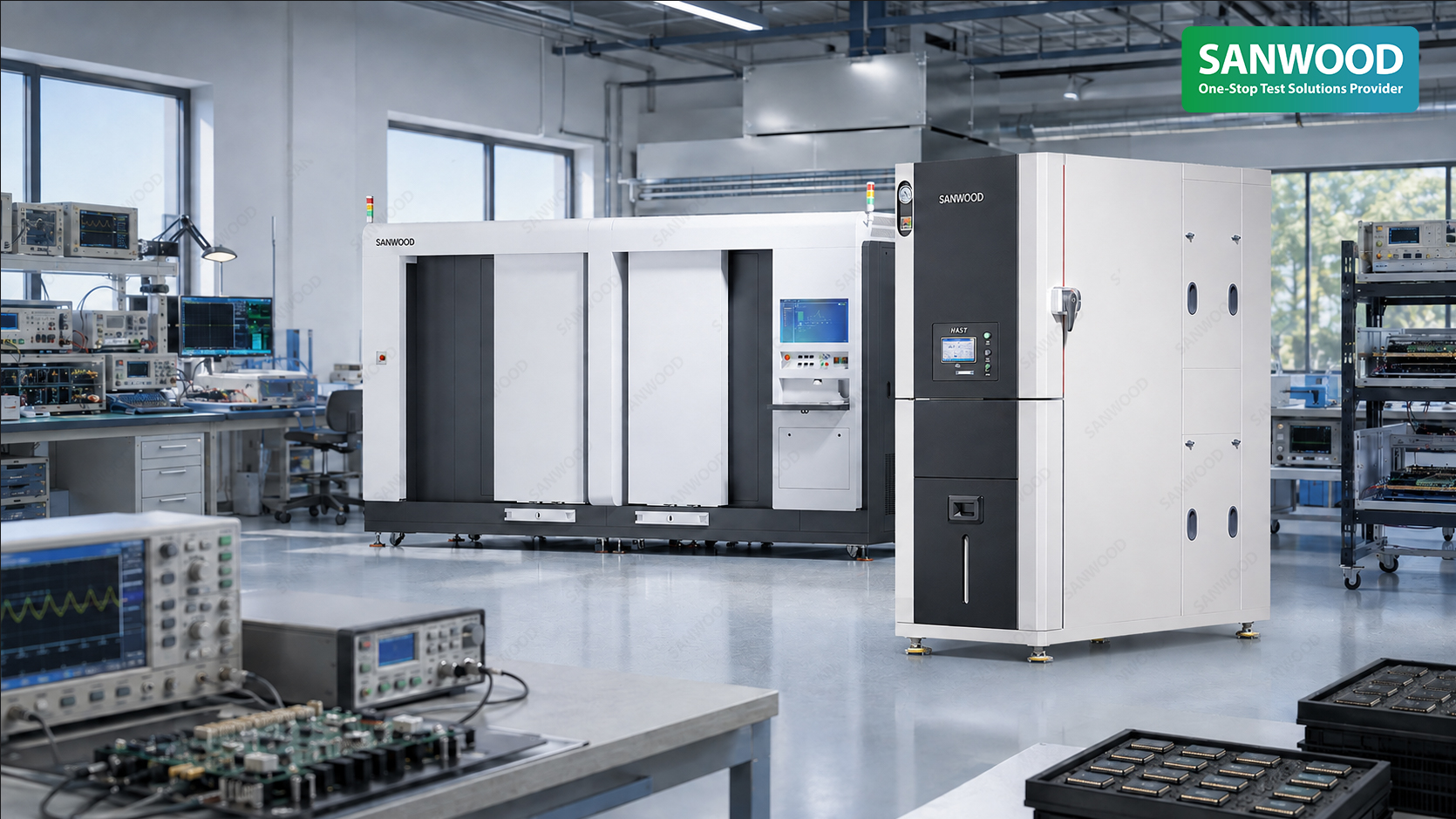
Selecting semiconductor reliability test chambers for an IC lab involves more than checking a published temperature range. An environmental test chamber—or climatic test chamber—can still be unsuitable once the actual load is considered: stacked burn-in boards restrict airflow, powered samples add heat, and biased HAST may require pressure-rated electrical feedthroughs. The chamber controller records environmental conditions, but it does not determine whether a semiconductor device passed its electrical acceptance criteria.
Start with the test method and the complete loaded arrangement. The chamber creates the required environmental stress; power, bias, signal generation, electrical measurement and failure analysis may belong to other parts of the laboratory system.
For a broader application overview, see semiconductor reliability testing.
Temperature appears in several semiconductor reliability methods, but it does not play the same role in each one. The applicable standard revision and customer specification define the profile, transfer method and acceptance criteria; a standard number by itself is not a complete chamber specification.
Test need | Chamber or system category | Selection question |
Accelerated moisture stress under pressure | HAST chamber | Is the method biased or unbiased, and what humidity, pressure and feedthrough arrangement apply? |
Powered operation on burn-in boards | BIB burn-in system | How will boards be powered, monitored and cooled in the loaded slot arrangement? |
Repeated programmed hot-cold exposure | Temperature cycling chamber | What transition rate and dwell must be achieved with the planned fixture and active load? |
Rapid exposure to specified hot and cold environments | Thermal shock chamber or system | Does the method require liquid transfer, air transfer or a stationary chamber profile? |
Temperature and humidity without pressure | Temperature-humidity chamber | Is the test powered, and how will wiring, sensors and condensation requirements be managed? |
Typical references include JEDEC JESD22-A110 for biased HAST, JESD22-A118 for unbiased HAST, JESD22-A104 for temperature cycling, JESD22-A106 for liquid-to-liquid thermal shock, and JESD22-A108 for temperature, bias and operating life. For air-based thermal shock or transfer systems, confirm the applicable method against the required medium and test profile. In every case, the laboratory needs to identify the current revision and any customer-specific deviations before the chamber is specified.
Depending on the method, the chamber controls temperature, humidity or pressure and provides the associated alarms, protective functions and environmental records. Cable ports, pressure-rated feedthroughs where required, and other mechanical interfaces are part of the project configuration.
The electrical scope needs its own definition. It may include power and bias distribution, signal generation, burn-in boards, channel-level measurement, failure detection and external data acquisition. A BIB burn-in system can integrate some of these functions, but the product category does not establish the complete supply boundary.
The proposal and interface drawing therefore need to show what SANWOOD supplies, what remains with the laboratory and how the two sides communicate. When several suppliers are involved, connector types, channel counts, signal levels, communication protocols and responsibility for interlocks should be settled before the interface design is approved.
Nominal workspace dimensions do not show what happens after boards, fixtures, cables and sensors are installed. A dimensioned layout should record test-item quantity and orientation, fixture dimensions, slot spacing, connector clearance, cable routes, feedthrough positions and loading access.
Powered testing adds another constraint: maximum simultaneous heat dissipation. The rated power of one device is not enough when many devices or boards operate together. The combined load affects refrigeration demand, temperature recovery and the usable space available for circulation.
A chamber may appear large enough from its internal dimensions, yet a fully populated BIB rack can narrow central airflow paths while harnesses occupy the remaining clearance. If the boards also dissipate heat, an empty-chamber result says little about conditions at the middle slots. The real question is whether the chamber, airflow arrangement and active load were evaluated together.
One published BIB Memory Burn-in Test System configuration lists two test areas and temperature control from −40°C to +150°C. Its description also addresses airflow between stacked boards. These details apply only to that configuration and still require review against the planned board layout, wiring and simultaneous heat load.
The chamber sensor indicates the condition at its measurement location. It does not necessarily represent the temperature of every device in a densely loaded fixture, nor does it show whether an electrical failure occurred during the stress period.
Loaded acceptance criteria need to identify chamber and test-item sensor positions, electrical values and channel counts, alarm or shutdown triggers, logging intervals and time synchronization. Where temperature deviation or recovery matters, the agreement should also state the probe layout, representative fixture and active load rather than relying on empty-chamber data.
Synchronized records make the test easier to interpret. If a device changes state during a run, the laboratory can compare the electrical event with the chamber profile and local sensor data instead of treating every failure as an environmental-control problem.
Published ranges are useful for an initial comparison, but final selection depends on the project configuration.
The current HAST Test Chamber page describes control of temperature, humidity and gauge pressure. For a specific project, the proposal should identify the biased or unbiased method, operating limits, feedthrough arrangement, sample loading and pressure-related installation provisions.
Temperature cycling and thermal shock require the same discipline. A nominal range does not demonstrate transition or recovery with the planned load. Where these factors affect acceptance, document the sample mass, fixture construction, test medium or transfer arrangement, and sensor locations in the technical agreement.
A chamber that suits the test can still be wrong for the site. Before final selection, confirm supply voltage and connected power, utilities such as cooling water or exhaust where applicable, room heat rejection, access, floor loading and maintenance clearance.
For HAST installations, include the operating and pressure-related provisions of the selected system. The approved installation drawing—not a general product description—should govern the final site review.
For international projects, SANWOOD can support on-site installation, maintenance and repairs. Service location, access conditions, customer responsibilities and the agreed scope should be confirmed before delivery.
Provide enough information to describe the real test rather than only its target temperature:
Test-item type, package and board or fixture format
Test method, customer specification and applicable revision
Temperature, humidity, pressure and time profile, including transition, dwell, transfer or recovery requirements where relevant
Test-item dimensions, quantity, loaded orientation and maximum simultaneous heat load
Powered or unpowered state, bias, wiring, feedthrough and external-instrument requirements
Sensor positions, channel count, logging, interlocks and loaded acceptance criteria
Laboratory utilities, loading route and installation constraints
With these inputs, the chamber or system category, loaded layout, performance requirement, interface responsibility and site conditions can be evaluated together rather than as separate decisions.
Not automatically. The chamber creates and records the environmental condition. Power, bias, pattern generation, electrical measurement, failure detection and result analysis may remain external unless they are included in the agreed system scope.
No. A conventional, non-pressurized temperature-humidity chamber is not a substitute for HAST. HAST requires elevated temperature, humidity and pressure, together with the provisions specified for the selected biased or unbiased method.
Verify the conditions that can change the result: agreed sensor positions, transition or recovery under a representative load, alarm and interlock response, data logging, and synchronization with the external electrical system. The acceptance plan should be agreed before manufacture or delivery, not reconstructed from a general data sheet afterward.
Share your test-item type, test standard and revision, temperature profile, heat load, sample quantity, monitoring requirements and installation conditions with SANWOOD. The chamber and interface recommendation will be evaluated against the complete project configuration.
Sanwood is not just a company; it is a commitment to delivering high-quality products that stand the test of time.

 English
 中 文


 info@sanwood.com