Q1: How does this thermal cycling chamber guarantee secondary fluid-loop safety during high-rate thermal transitions up to 150°C?
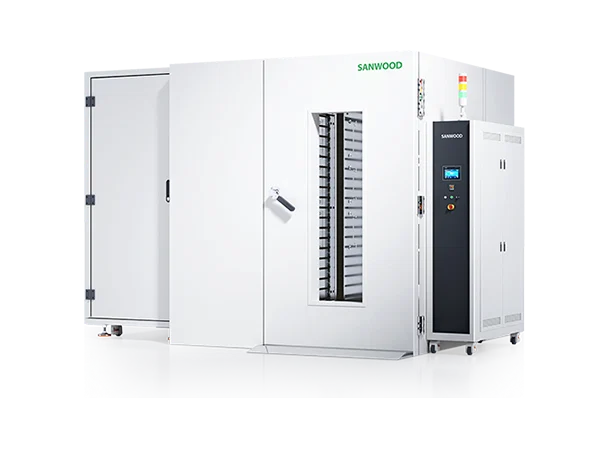
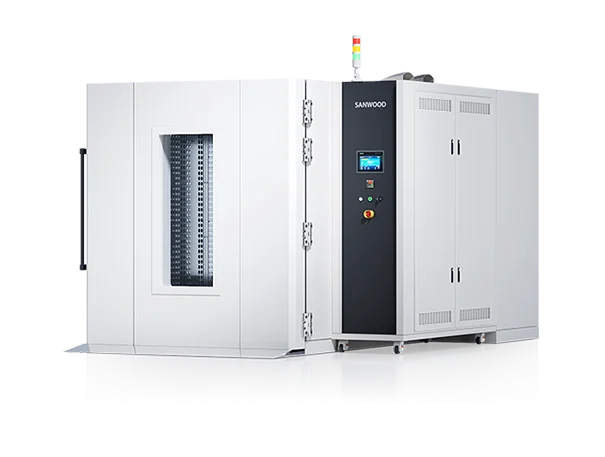
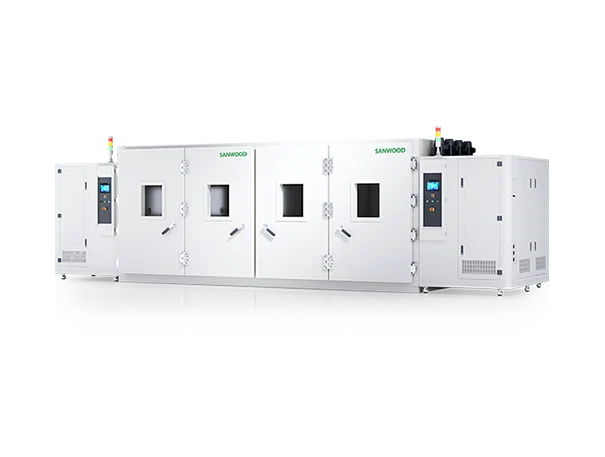
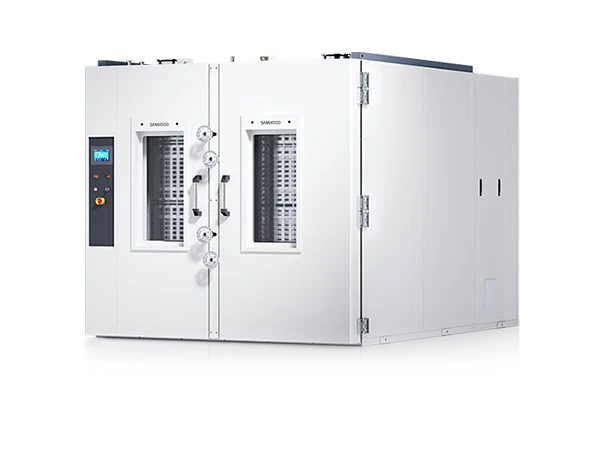
A: Testing operational CDUs at 150°C introduces major fluid expansion risks that can compromise couplings. Sanwood's specialized environmental test chamber platform isolates this hazard by embedding an active secondary fluid cooling loops control system that works in sync with the main chamber PID mesh. Additionally, the chamber floor is a fully welded, sloped stainless steel pan equipped with continuous optical fluid detection rings. If any manifold micro-leakage occurs due to quick-disconnect gasket failure during a rapid thermal ramp, the matrix sensors trigger a safe-shutdown loop and isolate the DUT power long before moisture can pool.
Q2: What mechanism prevents flow short-circuiting and airflow bypass when testing an entire row containment or pre-fabricated data center pod?
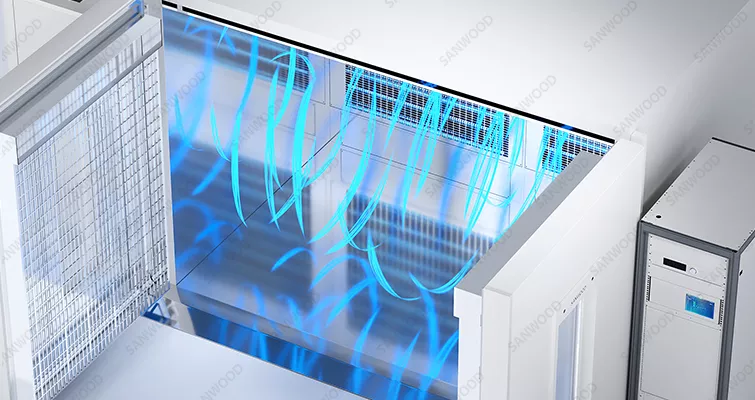
A: Large-scale row containments alter the internal aerodynamics of a chamber, causing vertical air to short-circuit through perimeter gaps and leaving the core micro-modules unexposed. Our specialized climatic test chamber platform neutralizes this bypass effect by integrating an array of adjustable floor-mounted velocity vector plenums and a high-static pressure side-wall wind wall. This configuration forces the conditioned air to mirror the exact row-containment airflow pathways used in live data centers, forcing the laminar thermal stream to punch directly through the modular sub-assemblies without leaving any dead zones.
Q3: How does the system eliminate latent condensation on liquid-cooling manifolds when returning from cold soaking back to high ambient conditions?
A: Returning a massive liquid-cooled manifold from -40°C back to hot ambient conditions naturally causes ambient humidity to condense on the freezing stainless steel pipes, triggering potential electrical path tracing. Our environmental test chamber platform completely overrides this condensation risk by layering an automatic, multi-stage desiccant dry air loop managed by real-time dew point calculation. Before shifting from the cold soak to the rapid heating ramp, the processing core floods the chamber with continuous dry compressed air, dropping the relative humidity strictly below 3% and keeping the local dew point securely far below the manifold surface temperature throughout the loop.

 English
 中 文
中 文


 info@sanwood.com