Q1: Why use a pneumatic carrier basket layout instead of conventional mechanical chain drives for high-velocity thermal shock transitions?
A: Launching a carrier basket vertically in under 10 seconds inherently introduces severe inertia profiles that can induce micro-cracks on delicate lead wires. Sanwood's specialized environmental test chamber overrides this mechanical backlash by pairing linear variable-frequency pneumatic actuator columns with heavy-duty dual-shaft hardened guiding rails. Additionally, integrated heavy-duty hydraulic deceleration dampers are hard-mounted at both travel limits. This layout flattens the final deceleration velocity curve smoothly right before latching, transforming a harsh physical snap into a zero-chatter soft landing that completely safeguards brittle wafer-level micro-bumps.
Q2: How does the twin-enclosure architecture seal out thermal bleeding when the pneumatic basket passes through the central zone boundary?
A: Cross-zone thermal bleeding during transit completely ruins local zone uniformities and degrades cooling compressor life. Our high-rate climatic test chamber platform eliminates this convective mixing by engineering a double-sided structural partition bulkhead built directly onto the upper and lower frames of the moving basket itself. Crafted from multi-layered aluminosilicate ceramic insulation armor and lined with continuous high-temperature, high-pressure inflatable fluorosilicone compression gaskets, these barriers slam tightly against CNC-machined structural interior jambs the instant the basket reaches its stop, securing an airtight thermal break that isolates the inactive zone completely.
Q3: What engineering controls guarantee a strict under-5-minute temperature recovery time when the chamber is heavily loaded with high-thermal-mass electronic assemblies?
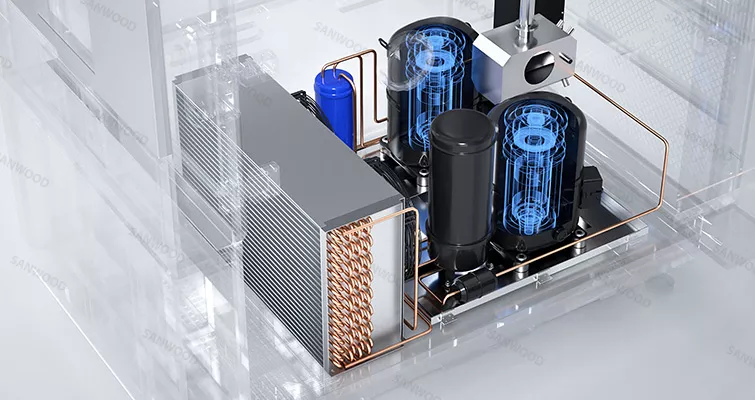
A: Introducing cold components into a hot zone (or vice versa) triggers a massive thermal lag that flattens the shock profile. Sanwood's advanced environmental test chamber defeats this thermal inertia by incorporating over-specified, low-lag nichrome heating arrays paired with an oversized, high-density thermal storage medium block in the cold reservoir. When the basket locks into place, predictive feed-forward control loops instantly dump large reserves of pre-conditioned thermal energy into a high-static pressure cross-flow wind-wall, forcing spatial uniformities to stabilize back below standard tolerances within 5 minutes even under saturation capacity loads.
Q4: How does the system mitigate evaporation coil icing and moisture accretion inside the deep-freeze enclosure during continuous multi-day testing cycles?
A: Continuous thermal shock cycles inherently pump trace ambient humidity into the deep-freeze chamber, causing rapid ice buildup on the cooling coils that chokes laminar airflow velocity. Our specialized climatic test chamber platform completely sidesteps this performance drop by running an integrated, automated dry air/nitrogen gas desiccant purge infrastructure linked to ambient dew-point matrix processors. Before triggering long-term test loops, the system blankets the entire internal environment with continuous positive-pressure desiccated gas, keeping internal relative humidity locked below 3% to guarantee zero coil icing and uncompromised wind velocity over weeks of non-stop testing operations.

 English
 中 文
中 文



 info@sanwood.com