Q1: How does this memory burn-in system eliminate thermal blockages and localized hot-spots when the chamber is entirely populated with high-density Burn-in Boards (BIBs)?
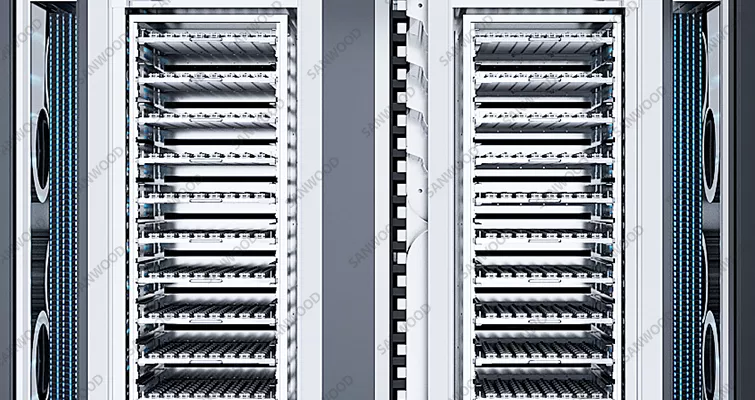
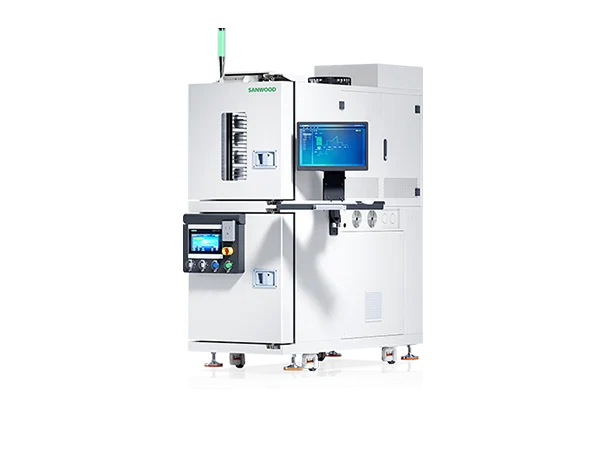
A: Air naturally skims around the perimeter of high-resistance testing fixtures, leaving the center channels starved of uniform flow and starved of heating. Sanwood's specialized environmental test chamber topology eliminates this bypass risk by incorporating a high-static pressure centrifugal wind-wall coupled with side-wall air-vector redirection plates. This forces the air to move horizontally as a rigid laminar sheet directly through the narrow channels between stacked BIB cards. By actively scrubbing away the static boundary layers clinging to individual memory IC encapsulations, it clamps the multi-tier spatial temperature uniformity strictly within a tight ±1.5°C window at 125°C hold.
Q2: What specific shield metrics protect delicate pattern generator high-frequency clock signals from impedance drift during continuous 150°C thermal baking runs?
A: Sustained high thermal exposure inside a climatic test chamber causes conventional board links to expand microscopically, changing their dielectric constants and triggering severe clock skew on high-speed data buses. To preserve signal integrity, our system integrates custom, military-grade high-Tg polyimide base material for all internal pass-through interface board layers. Every signal trace is route-optimized via balanced differential striplines with characteristic impedance controlled tightly within ±5% tolerance windows, paired with heavy gold-immersion finishing. This completely eliminates internal wave reflections and prevents false link dropouts across thousands of continuous runtime testing hours.
Q3: How does the power safety network isolate a single failing memory IC during dynamic electrical testing to prevent localized thermal cascading across the entire test board?
A: During dynamic stress screening within an environmental test chamber, a memory device suffering from dielectric breakthrough will enter latch-up, pulling excessive current that destroys surrounding DUTs or burns the parent BIB card. Our test architecture eliminates this cascading risk by deploying a distributed, multi-channel smart digital monitoring network featuring microsecond-level programmable protection chips assigned to every slot. The microsecond an abnormal current draw or impedance collapse is registered from a single memory device, the master logic controller automatically trips that specific channel's sub-rack power relay, instantly cutting the active electrical footprint of the failed DUT without interrupting the test cycles of adjacent chips.

 English
 中 文
中 文








 info@sanwood.com