Q1: Why do ESSD verification profiles demand specialized high live-load heat compensation compared to standard CSSD testing layouts?
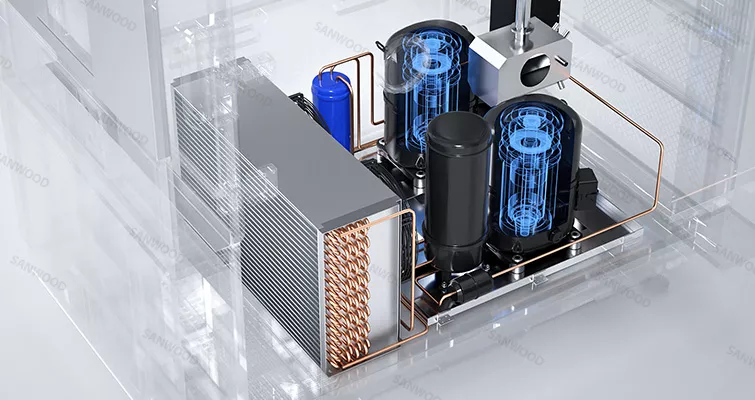
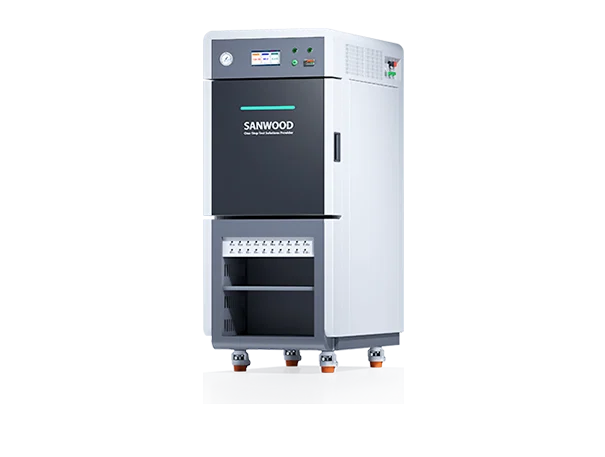
A: While Client SSDs (CSSD) usually pull between 5W to 8W per drive, Enterprise SSDs (ESSD) pull up to 25W to 40W each due to continuous high-throughput enterprise enterprise workloads and large flash controller arrays. When you cluster 256 or 512 of these enterprise drives inside a single testing rack, the passive heat generation scales to an aggressive 8 kW or 10 kW. A standard environmental test chamber cannot dump this massive thermal surge; its cooling coils immediately saturate, causing a complete flattening of the temperature ramp slope and thermal runaway. Sanwood's specialized storage system utilizes a dedicated feed-forward proportional refrigerant control system that monitors the active current draw from the test backplanes, injecting real-time excess cooling energy directly into the laminar airflow loop to neutralize the multi-kilowatt drive heat instantly.
Q2: How does the climatic test chamber prevent destructive condensation on dense M.2 and U.2 interface backplanes during aggressive sub-zero temperature cycling?
A: Rapidly transitioning from +150°C down to sub-zero zones causes ambient moisture to immediately condense and frost on high-density interface connectors and active golden fingers, triggering fatal electrical short circuits and signal dropouts. Our specialized climatic test chamber blocks this hazard by fully sealing the internal environment and integrating an automated, ultra-low dew point compressed dry air or high-purity nitrogen (N2) purge system. Before the chamber initiates its negative thermal ramp, the system injects dry air to force internal relative humidity below 3%, establishing an absolute dry barrier around high-value Gen5 testing assets to secure complete frost-free operation.
Q3: How does the chamber's interface architecture handle high-frequency impedance drift for PCIe Gen5/Gen6 data links across the full -40°C to +150°C thermal envelope?
A: Extreme temperature fluctuations cause micro-scale physical expansion and contraction in testing boards, which can severely distort trace capacitance and drive differential impedance outside standard limits. Sanwood eliminates this by utilizing custom, military-grade high-Tg Teflon and polyimide composite substrates for all inner host backplanes. Combined with localized copper-shielded microstrip lines and continuous gold-immersion finishing, the differential trace impedance remains rigidly locked within the standard 85-ohm/100-ohm window across the entire environmental test chamber operational span, preventing false-positive data link dropouts or receiver bit slips.
Q4: Can the testing rack asynchronously execute client-level low-power states and enterprise continuous full-stroke stress testing within a single profile run?
A: Yes. Designed for versatile R&D laboratory and high-mix QA workflows, the chamber's integrated power distribution matrix houses independently programmable, multi-channel DC power domains. Engineers can assign isolated voltage profiles and dynamic test patterns to separate sub-racks concurrently. This means you can run asynchronous, low-power state transitions (e.g., PCIe L1.2 sleep modes) on client M.2 batches on one side of the chamber, while running maximum-throughput enterprise IOPS workloads on U.2 ESSD batches on the other side, squeezing maximum utility out of a single thermal cycle run.

 English
 中 文
中 文


 info@sanwood.com