Q1: Why should an R&D laboratory or semiconductor Fabless company select a compact single-door walk-in chamber over a large double-door mass-production setup?
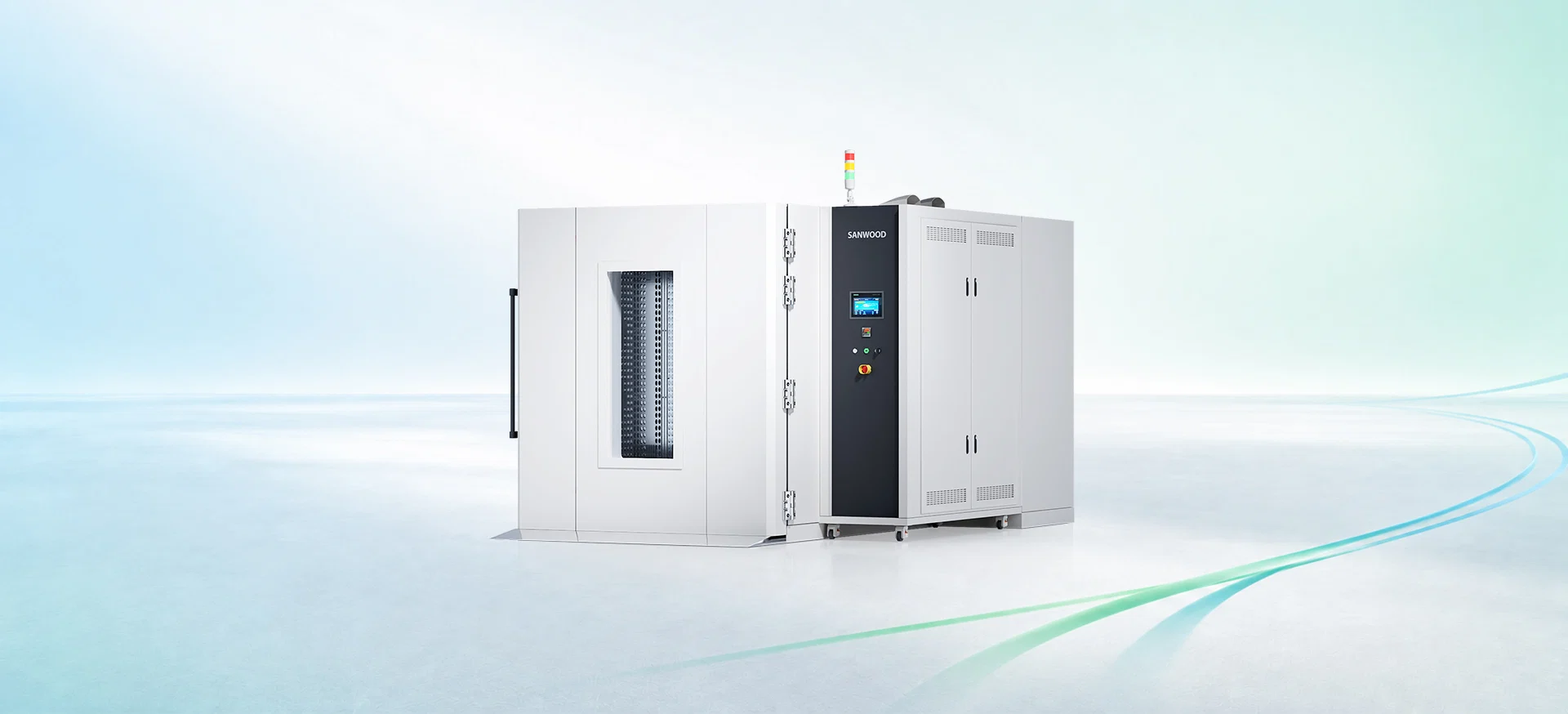
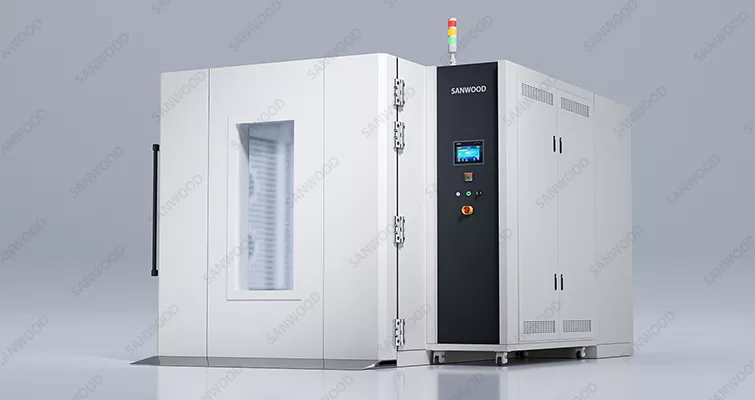
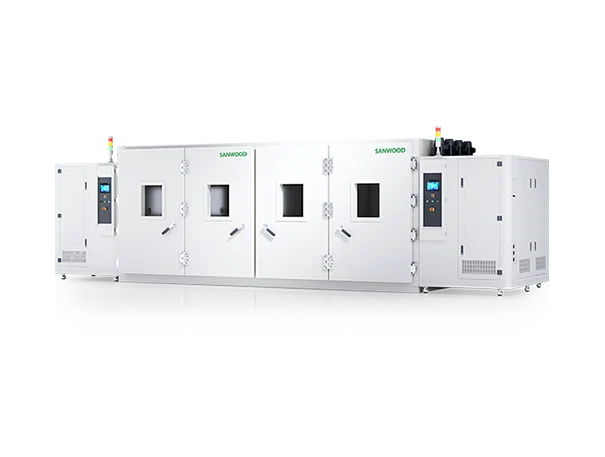
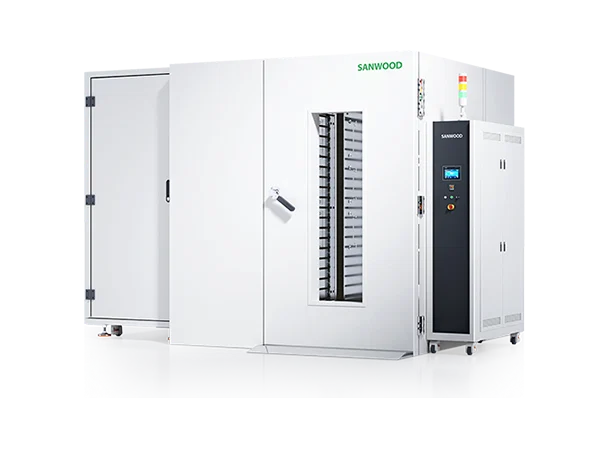
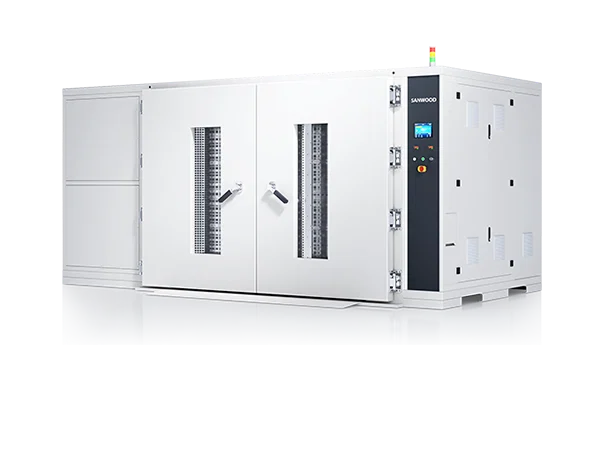
A: Large double-door setups are engineered for high-volume manufacturing but are highly inefficient for R&D laboratories and failure analysis centers. A massive chamber demands significant facility floor space, mandates expensive infrastructure retrofits, and pulls excessive utility power even when testing a small batch of prototypes. Sanwood's single-door environmental test chamber packs world-class thermal precision into a footprint-optimized shell. It passes easily through standard lab doors and integrates into Class 1000 cleanrooms without disruptive airflow alterations, allowing engineering teams to run high-fidelity HTOL profiles on small-mix prototype batches while slashing utility operational costs.
Q2: How does this compact walk-in chamber achieve world-class 3D spatial temperature uniformity inside a tighter geometric interior?
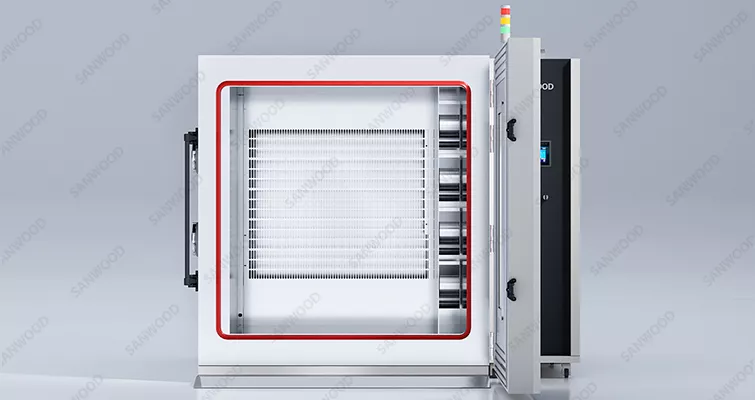
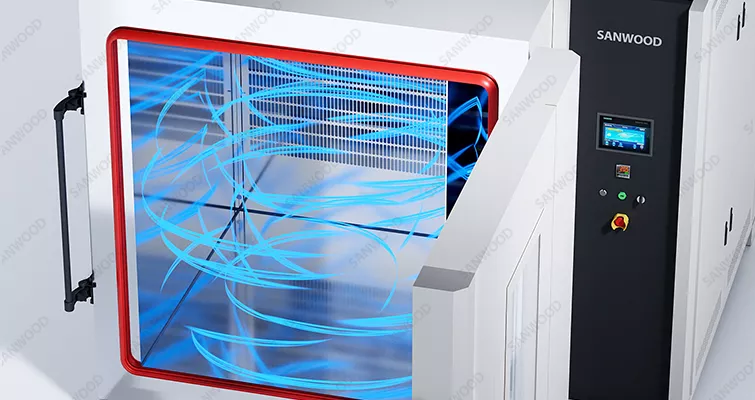
A: Tighter geometric spaces are prone to rapid air choking when dense testing card cages obstruct the paths. Traditional static ovens create significant hot-spots and micro-climate stratification under these conditions. Our specialized climatic test chamber overrides this layout obstruction by integrating a high-displacement rear-wall centrifugal blower assembly coupled with dual lateral aerodynamic flow-equalizing plenums. This system forces conditioned air to sweep horizontally across every shelf layer at an optimized velocity profile. By aggressively tearing down the stagnant thermal boundary layers surrounding active test cards, it locks the spatial temperature deviation strictly below ±1.5°C at a continuous 150°C hold, delivering premium, repeatable validation precision across all slots.
Q3: What engineering safeguards prevent high-frequency data links from suffering impedance drift and signal degradation under prolonged continuous 150°C baking runs?
A: Sustained high-heat exposure inside an environmental test chamber triggers microscopic expansion in standard PCB traces, altering the dielectric constant and inducing severe signal attenuation on critical clock and data lines. To enforce pristine signal integrity, Sanwood utilizes custom, military-grade high-Tg polyimide base substrates for all internal pass-through board layers. All trace pathways are route-optimized via balanced differential striplines with impedance controlled tightly within ±5% tolerance windows, paired with heavy gold-immersion finishing. This blocks internal wave reflections and prevents false-positive link dropouts across thousands of continuous testing hours.
Q4: How does the thermal break seal design of this single-door climatic test chamber eliminate factory floor heat radiation while keeping the outer skin completely safe to touch?
A: Operating a walk-in chamber up to 150°C inside a localized lab creates severe comfort challenges if heat bleeds out into the cleanroom facility. Our specialized climatic test chamber eliminates this facility thermal loading by layering premium, high-density aluminosilicate ceramic-fiber insulation breaks behind the internal steel sheet metal, forming a 100mm thick continuous thermal block. The single-door interface is sealed using an interlocking dual-path, hollow-core high-temperature silicone gasket system compressed tightly by adjustable heavy-duty multi-point cam latches. This architecture shuts down thermal migration entirely, preventing ambient humidity ingress and keeping the external skin temperature completely cold to touch.

 English
 中 文
中 文


 info@sanwood.com