Q1: How does a CO2 refrigerant chamber manage the extreme high pressures associated with R744 transcritical cycles compared to standard HFC chambers?
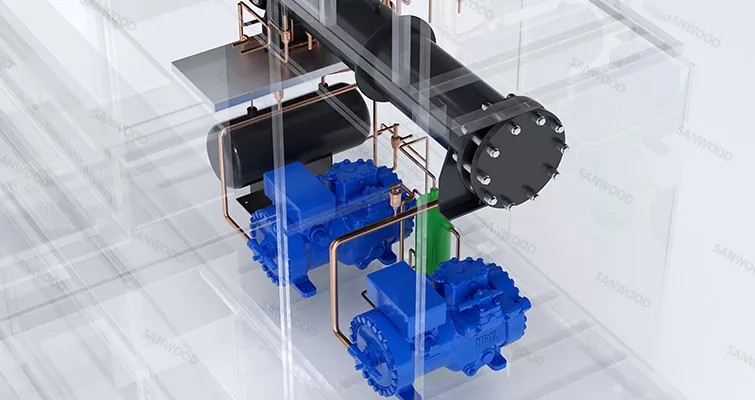
A: Natural R744 (CO2) operates at significantly higher thermodynamic pressures than traditional synthetics like R404A, requiring transcritical pressures up to 130 bar during high ambient operations. Sanwood’s specialized environmental test chamber platform neutralizes this stress by incorporating a heavy-wall, micro-bore stainless steel piping network coupled with multi-layered high-rigidity structural joints. Furthermore, the compressor loop is backed by an automated dual-path mechanical rupture safety assembly and digital high-pressure transient transducers, instantly mitigating sudden thermal expansion spikes and isolating the refrigeration loop safely long before factory facility stress boundaries are crossed.
Q2: Does switching to eco-friendly CO2 refrigerant degrade the low-temperature pull-down rate or spatial uniformity inside the chamber workspace?
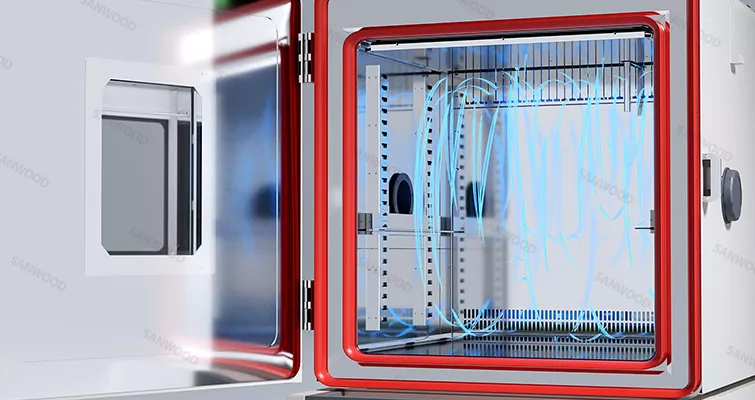
A: Absolutely not. CO2 actually possesses exceptional volumetric cooling capacity and superior heat transfer fluid dynamics compared to HFC alternatives. Our high-rate climatic test chamber architecture takes full advantage of these properties by embedding an optimized Internal Heat Exchanger (IHX) network that supercools the fluid before expansion. This layout guarantees sharp temperature pull-down rates down to -40°C that meet or exceed standard chemical configurations, while our high-static centrifugal wind-wall delivers an uncompromised spatial temperature uniformity strictly below ±0.5°C across the entire testing grid.
Q3: What engineering controls prevent CO2 refrigerant "dry ice" freezing blockages inside the capillary expansion network during continuous sub-zero testing?
A: If trace liquid moisture gets introduced into an R744 refrigerant loop, the intense pressure drop at the expansion mechanism can cause the CO2 to cross its triple point, transforming instantly into solid dry ice that blocks the line and locks the system. Our advanced environmental test chamber platform preempts this failure mode by incorporating a dual-stage molecular desiccant inline filtration cluster that continuously strips out sub-ppm level moisture from the internal refrigerant. This is paired with custom electronic expansion valves featuring high-frequency anti-clog pulse programming, ensuring consistent, unrestricted fluid tracking during non-stop multi-day sub-zero runs.
Q4: How does the integrated CO2 gas cooler system manage heat rejection and optimize energy efficiency in laboratories with higher ambient temperatures?
A: In high ambient environments, CO2 cooling cycles operate entirely in the transcritical zone, where standard condensation cannot occur, relying heavily on gas cooler heat dissipation. To maintain high efficiency under these conditions, Sanwood implements an adaptive, feed-forward fan speed regulation matrix across the oversized gas cooler block. The processor real-time monitors the cooling media temperature and modulates high-static pressure fans to optimize heat rejection. This control loop minimizes the transcritical gas cooler exit temperature, successfully scaling down facility grid power spikes and preventing high-pressure safety cutouts even during extreme summer laboratory ambient surges.

 English
 中 文
中 文



 info@sanwood.com