Q1: Why does advanced IC qualification require a dynamic vector-driven aging system rather than a standard static baking chamber?
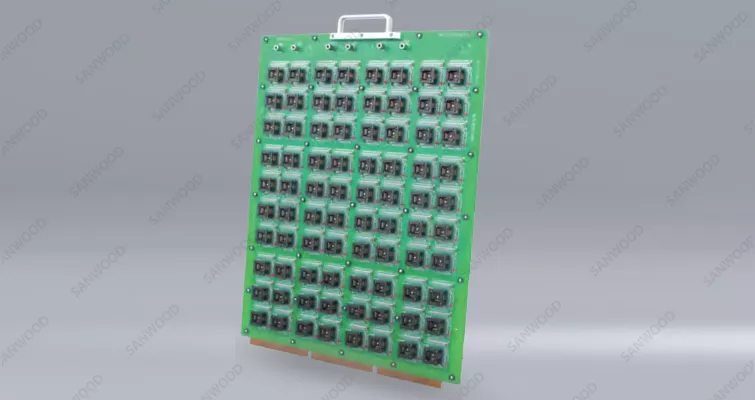
A: Static baking ovens only apply pure passive thermal strain to the chip shell and package interfaces. This completely fails to stress the internal logic paths, oxide layers, and transistor junctions. Critical failure mechanisms—such as gate dielectric breakdown, electromigration in metal traces, and high-frequency timing drift—only manifest when the IC is actively toggling logic states and drawing operational current. Sanwood's specialized environmental test chamber layout integrates high-speed algorithmic pattern generators directly into every slot interface. By continuously driving complex input vector patterns while maintaining a uniform 150°C profile, it actively triggers current-dependent silicon flaws and latent firmware lockups that a static oven would let slide through undetected.
Q2: How does a single-door climatic test chamber manage intense temperature overshoots when packed with high-power automotive GPUs or AI accelerators?
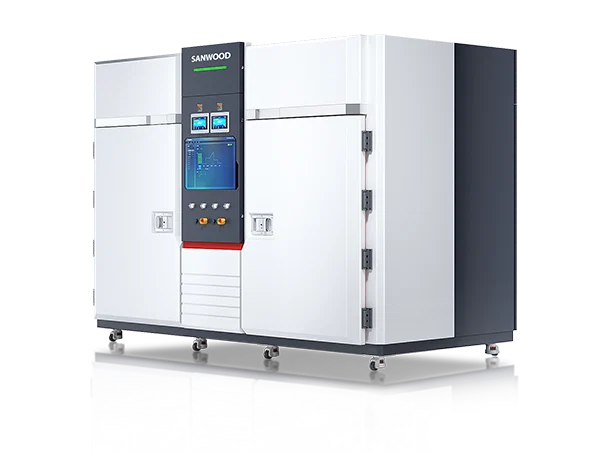
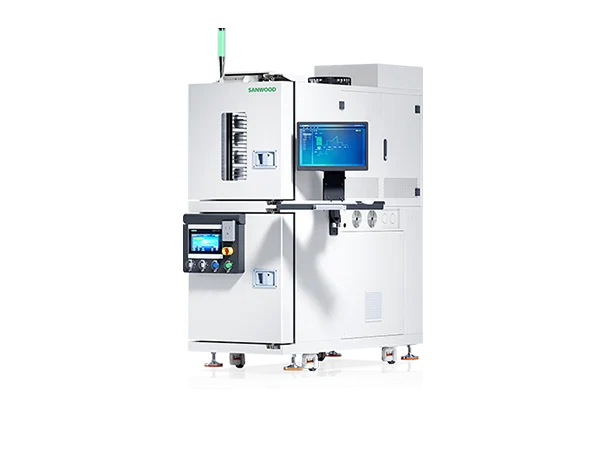
A: High-power DUT arrays generate immense active thermal dissipation. When thousands of accelerator cores are powered up, they act as an aggressive heating source inside a compact single-door space, which normally overwhelms standard airflow loops and triggers temperature overshoot. Our specialized climatic test chamber resolves this by deploying a forward-looking predictive temperature control algorithm. System telemetry constantly tracks the real-time electrical power draw of the inner driver backplanes. The moment an IOPS burst or peak processing matrix is detected, the controller dynamically activates multi-stage refrigeration bypass lines and micro-modulates electronic expansion valves, injecting instant excess cooling capacity right before the DUT heat spike hits the chamber workspace, locking the temperature deviations below ≤ ±1.5°C.
Q3: What specific engineering safeguards prevent a single-pin Latch-Up event on one DUT from triggering a catastrophic thermal runaway across the entire test board?
A: Latch-up is a severe parasitic short-circuit condition inherent in CMOS structures that causes anomalous high current draw, which can instantly vaporize chip bond wires and destroy adjacent testing equipment. To protect high-value engineering samples, our dynamic system features individual, isolated programmable driver-sensor circuits with dedicated microsecond-accurate over-current protection (OCP) loops assigned to every single pin. If a DUT enters a latch-up state or exhibits localized current leakage mid-cycle, the system immediately senses the sub-milliampere deviation, drops the localized power rail to zero within microseconds, and flags the failure log—fully isolating the bad silicon while the rest of the testing array continues uninterrupted execution.
Q4: For lab and cleanroom spaces, how does the single-door layout balance footprint optimization with strict 3D temperature uniformity requirements?
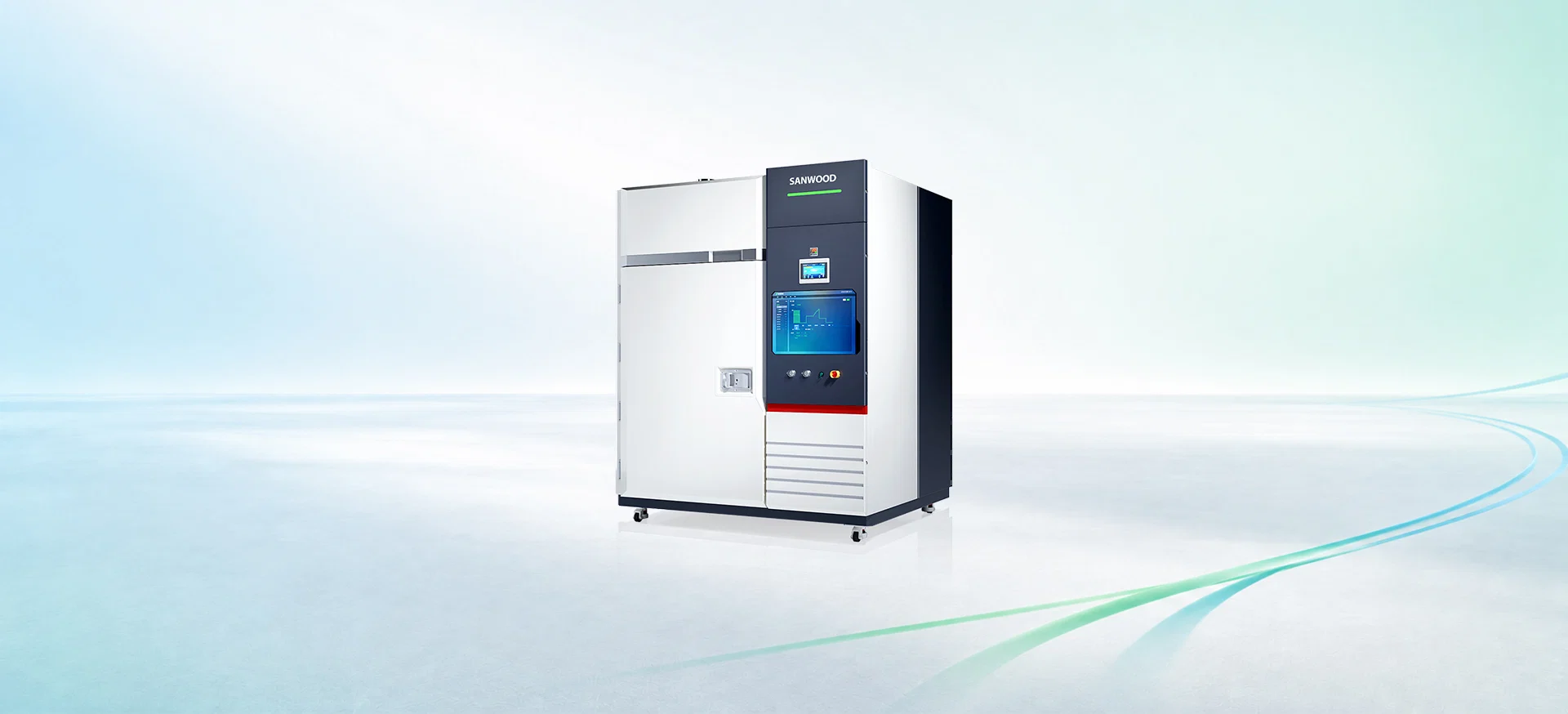
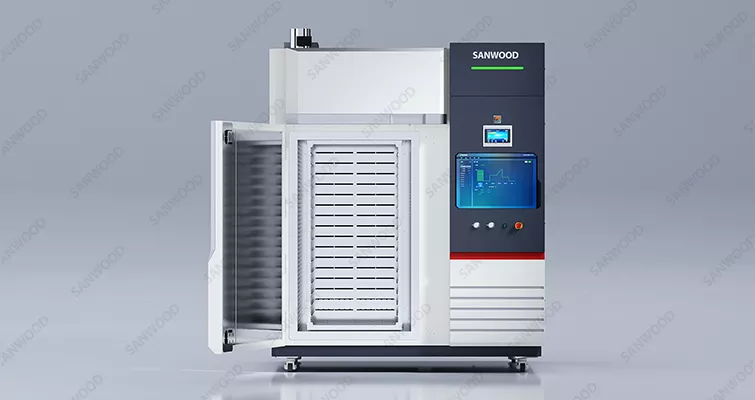
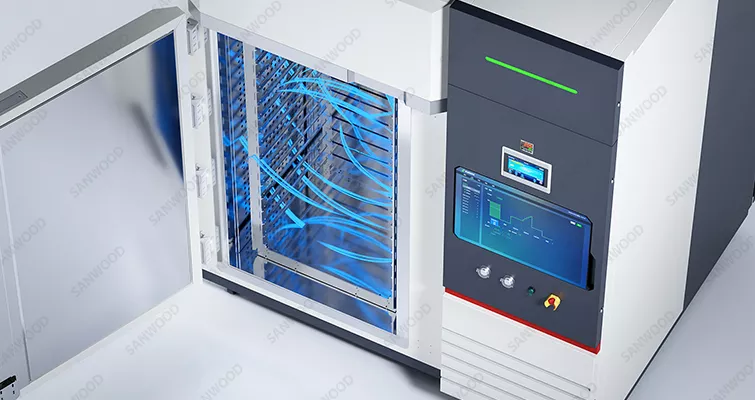
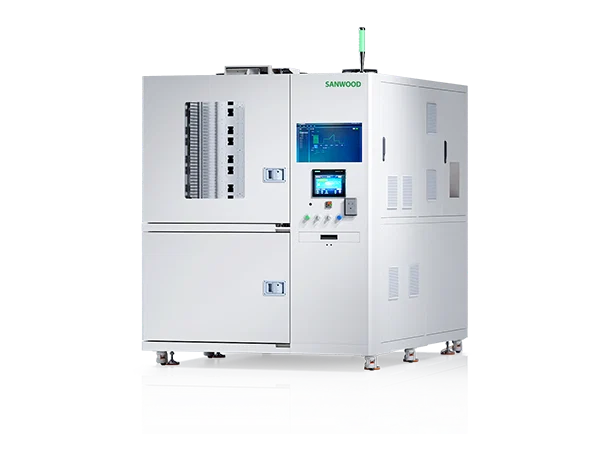
A: Cleanroom and laboratory space comes at a premium, making heavy walk-in structures highly restrictive. Our rigid single-door framework minimizes floor utilization while packing maximum channel densities. To ensure that this localized consolidation doesn't degrade spatial temperature uniformity, the chamber interior implements a rear-wall high-static centrifugal fan array mated to dual lateral laminar-flow air conditioning ducts. Air is forced horizontally across every card slot layer at a tightly metered velocity profile, breaking the thermal boundaries around dense testing card cages. This ensures that even when running at a full 150°C steady-state, the spatial temperature deviation across the entire single-door workspace is rigidly maintained under ±1.5°C, providing world-class testing precision in a compact footprint.

 English
 中 文
中 文


 info@sanwood.com