Q1: Why does a standard temperature/humidity room fail when testing active AI server racks under high-altitude low-pressure simulation?
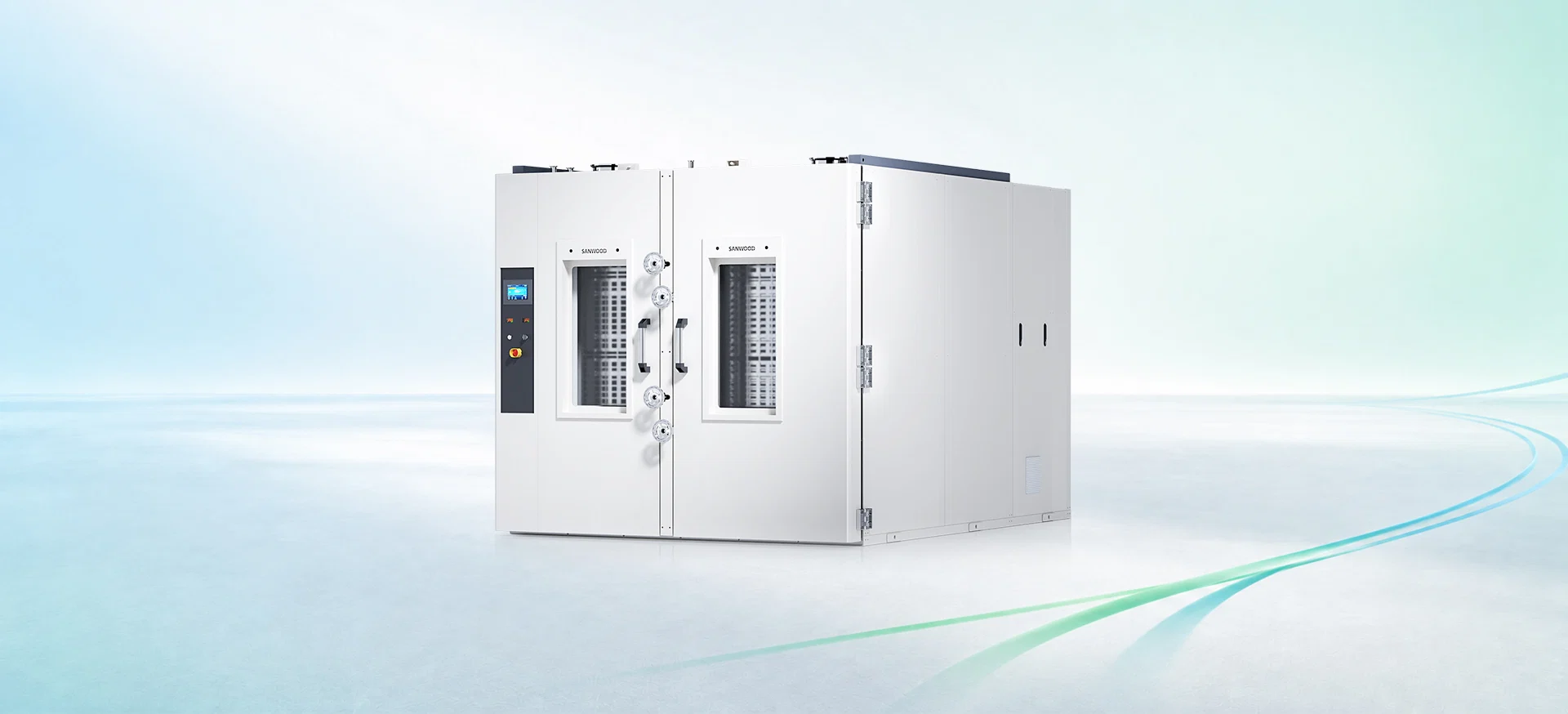
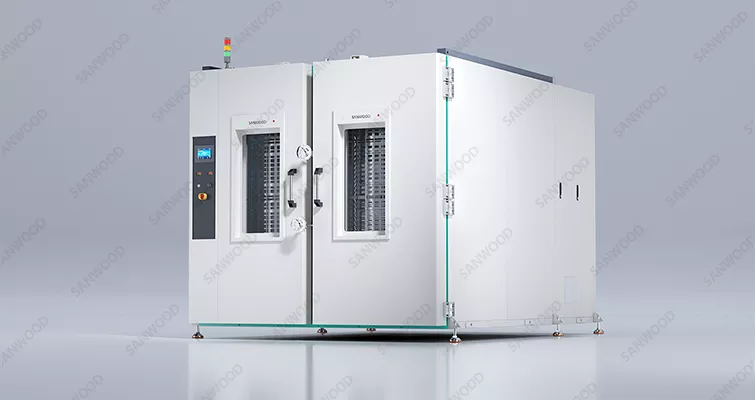
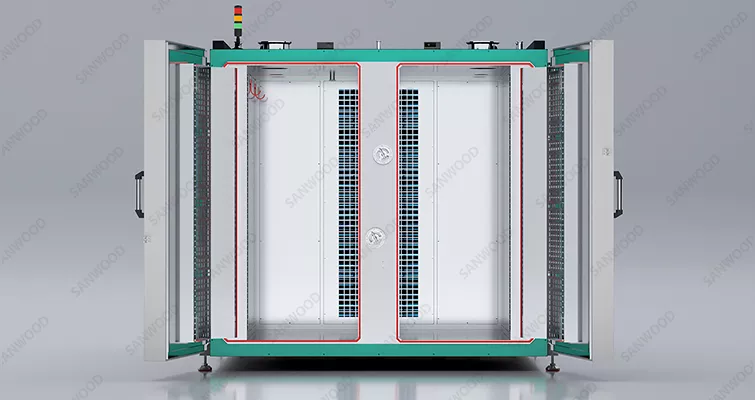
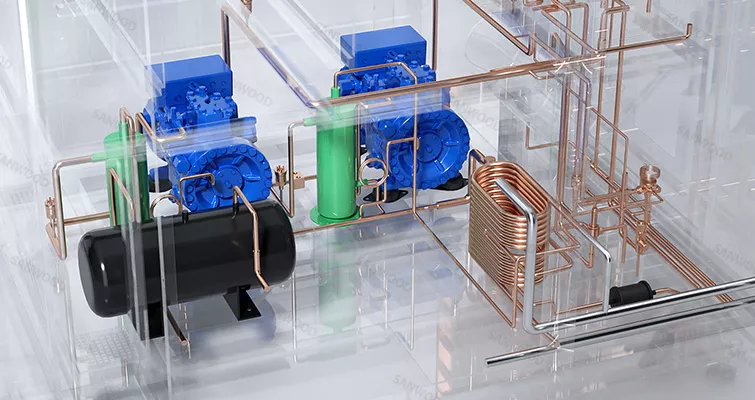
A: Standard rooms only regulate thermal mass at normal ground pressures where air density is constant. When an AI server rack operates at full capacity, it relies heavily on the mass flow rate of air to carry heat away from high-power GPUs. Under high-altitude simulation, the air density drops severely, which cuts the convective heat transfer coefficient by up to half. A standard single-stage system cannot handle the resulting heat buildup and vacuum pressure differentials. Sanwood's specialized environmental test chamber integrates an automated vacuum control line that drops down to 11.6 kPa while deploying an over-specified refrigeration bypass matrix. This allows it to absorb up to 80 kW of live operational heat from the server racks even when the internal air is too thin to provide efficient natural cooling.
Q2: How does the chamber structure handle the immense physical force generated by vacuum pressure differentials without imploding?
A: A walk-in system features a massive wall surface area. When the inner pressure drops down to a deep vacuum, the atmospheric pressure differential creates an immense implosion force pushing inward on the chamber walls. To eliminate the risk of structural buckling or weld failure, this climatic test chamber utilizes a heavy-gauge, structural carbon-steel external exoskeleton, fully welded to internal box-section reinforcement rib matrices. The interior liner is crafted from high-tensile 304 stainless steel with continuous argon-arc welds that are vacuum leak-tested using helium mass spectrometry, ensuring complete structural hermeticity and absolute operational safety across thousands of vacuum decompression cycles.
Q3: What is Paschen's Law, and how does this testing facility address it for next-generation high-voltage AI server power systems?
A: Paschen's Law is an empirical principle dictating that the breakdown voltage of a gas is a non-linear function of gas pressure and gap distance. As the air pressure decreases inside an altitude chamber, the mean free path of electrons widens, meaning fewer collisions occur, allowing electrons to accelerate to higher kinetic energies over a given distance. This dramatically lowers the voltage threshold required to ionize the air, triggering immediate high-voltage arcing, corona discharge, or dielectric insulation breakdown on high-voltage server power supply units (PSUs) and smart PDU busbars. Our facility directly secures these high-risk zones by incorporating high-sensitivity electronic ion-current leakage sensors and high-speed optical flashover matrix detectors. If localized dielectric ionization is detected on the server rack before a full short-circuit arc forms, the system triggers a microsecond-accurate emergency cutoff sequence, killing the DUT power rails to save the high-value computing components from catastrophic electrical destruction.
Q4: How does the walk-in system handle the condensation risks during rapid transitions from sub-zero high-altitude profiles to ambient ground conditions?
A: Rapid repressurization with ambient factory air introduces humidity into a cold chamber, causing instant condensation and frosting on high-frequency server interposers, which leads to signal degradation and short circuits. Our system prevents this by incorporating an integrated, high-volume dry air/nitrogen purge management loop. Before the chamber initiates its pressure recovery slope back to ground conditions, the system injects continuous streams of ultra-low dew point compressed dry air to displace moist internal gas. This ensures that the local dew point temperature inside the chamber remains locked far below the surface temperature of the server racks, guaranteeing completely dry, frost-free operation across the entire profile transition.

 English
 中 文
中 文


 info@sanwood.com