Q1: Why is pseudo-random pneumatic repetitive shock in a HALT chamber significantly more effective at precipitating defects than a traditional electrodynamic shaker?
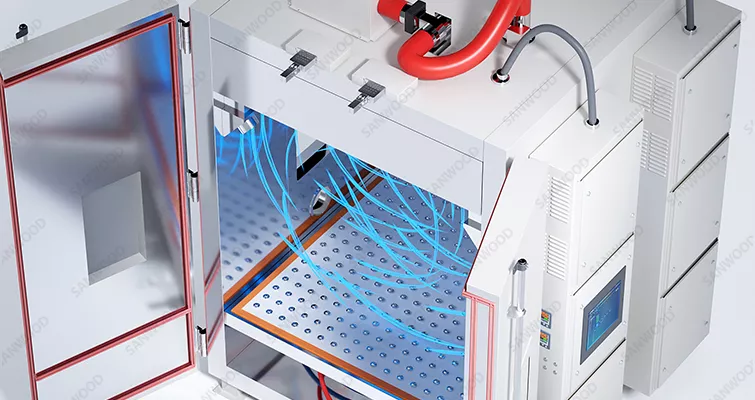
A: Traditional electrodynamic shakers are limited to single-axis execution (X, Y, or Z) and utilize controlled sinusoidal or random spectrums that may miss complex axis-coupling resonance. Sanwood's environmental test chamber utilizes a bottom-mounted matrix of pneumatic actuators striking the vibration table at non-synchronous intervals. This creates true 6-DoF pseudo-random vibration, exciting all structural resonant frequencies simultaneously. It forces complex multi-axis shear stresses on PCB solder joints and connectors, exposing latent mechanical cracks in hours that single-axis shakers would take days to isolate.
Q2: How does this climatic test chamber manage continuous 65°C/min thermal ramps without causing structural thermal shock destruction to the chamber shell itself?
A: Achieving a 65°C/min ramp requires balancing massive thermal kinetic energy. During liquid nitrogen (LN2) injection, the inner workspace drops from +150°C to -60°C in under four minutes. To prevent severe stress fracturing on the inner framework, this climatic test chamber utilizes a heavy-gauge, fully welded 304 stainless steel interior liner with specialized floating expansion joints. The shell is isolated from the chassis using a thick layered ceramic-fiber and polyurethane insulation break matrix, allowing the internal chamber to distort under extreme thermal gradients without transferring structural stress or warping the external sheet metal.
Q3: How do test engineers derive the HASS production-screening profile from HALT destructive limits without causing cumulative fatigue damage to good units?
A: HALT establishes the Upper/Lower Operational Limits (UOL/LOL) and Destructive Limits (UDL/LDL). Once these destructive thresholds are mapped, the HASS profile is engineered as a scaled-down stress baseline (typically choosing vibration levels at 50% of the HALT destruct Grms and tempering the thermal extremes). To guarantee this screening profile doesn't consume excessive fatigue life from good production lots, we execute a rigorous Proof-of-Screen (POS) protocol. Units are subjected to multiple consecutive HASS runs (e.g., 10 to 20 cycles); if the hardware survives without degradation and passes full functional telemetry, the HASS profile is validated as non-destructive and safe for line deployment.
Q4: What specific mitigation strategies prevent the pyroelectric noise and thermal drift on vibration control sensors under 65°C/min transition profiles?
A: Extreme temperature rates generate violent pyroelectric charging inside standard piezoelectric crystals, resulting in severe baseline signal drift and control loop instability. Sanwood resolves this by using customized, shear-mode quartz accelerometers coupled with hardline mineral-insulated (MI) cabling running through the testing space. These specialized sensors are mechanically isolated from the resonance table via low-thermal-conductivity ceramic isolation bases, blocking direct heat transfer and stabilizing the real-time Grms acceleration loop under intense thermal gradients.

 English
 中 文
中 文


 info@sanwood.com