2026-09-23 17:47:23
HAST test chamber selection requires more than matching separate catalog ranges. A reviewable proposal identifies the temperature, humidity and pressure offered together for the intended test, defines any electrical connection across the pressure boundary, and shows how the samples will be loaded. As a specialized environmental test chamber, the equipment should be assessed alongside the fixtures, electrical setup and documents needed to support the qualification plan.
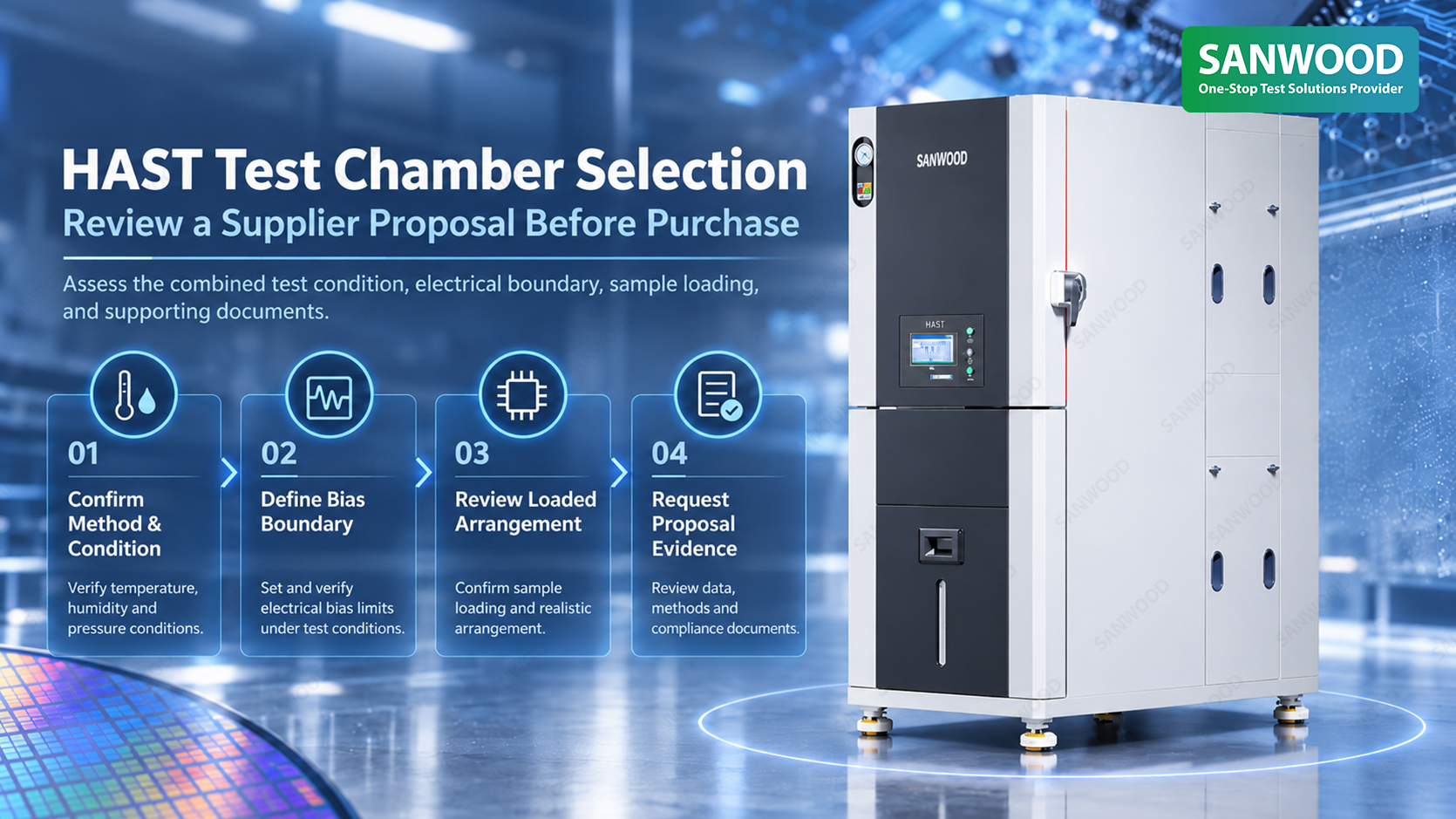
Start with the method and revision specified by the qualification plan or customer. Record the required temperature, humidity and pressure condition, exposure period, device under test (DUT), fixture, sample quantity and electrical state. If the method is still undecided, resolve it before approving a final chamber configuration. SANWOOD's semiconductor reliability test methods guide provides a starting point for distinguishing the method categories.
State whether a pressure value is gauge or absolute. Also separate the required exposure condition from heat-up, cooldown and sample-handling requirements. Separate maximum values for temperature, humidity and pressure do not establish that the quoted configuration can provide the required combination.
SANWOOD's HAST parameter sheet lists a temperature control range of +105°C to +135°C; a +145°C version is a special option. The current SANWOOD product page gives the same temperature range and optional limit. Confirm the version quoted for the intended test and ask for the required temperature, humidity and pressure as a combined operating condition. A temperature limit alone does not establish performance for the loaded test setup.
SANWOOD's HAST test chamber product page discusses electrical connections and post-test pressure and drying control. Use those descriptions to frame questions about the actual offer; confirm which arrangements and documents apply to the configuration being quoted.
For a biased test, ask where SANWOOD's equipment supply ends and the laboratory’s electrical setup begins. What connection across the pressure boundary is proposed? Who supplies the bias source, internal wiring and fixture? Which equipment records DUT electrical measurements? Ask which post-test operating steps apply to the offered configuration and where those steps will be documented.
The answers should describe one proposed setup. A general feature description cannot resolve an unspecified interface or establish that a laboratory’s existing bias equipment will connect to it.
Read the proposal in two passes: first identify what is included, then identify what will substantiate it. The table below is a buyer's review tool, not a list of standard SANWOOD features or completed acceptance results.
| Requirement to review | What the proposal should identify | Evidence or review basis to request |
| Combined test condition | Temperature, humidity and pressure offered together; gauge or absolute pressure reference | Operating information for the quoted configuration and an agreed measurement basis |
| Bias during exposure, if required | Connection across the pressure boundary; responsibilities for the supply, wiring, fixture and measurement | Electrical interface drawing and recording scope |
| Loaded samples | DUT quantity and arrangement, fixtures, connectors, cable routing and access | Review of a representative loaded arrangement |
| Non-condensing exposure, where required | Applicable test stage, sample arrangement and proposed operating approach | Governing method and agreed assessment basis |
| Installation and records | Site provisions, documents and recording functions included in the offer | Quoted installation information and proposed record set |
For each open item, record its owner and decision stage. Questions that affect the combined condition, electrical supply boundary or loaded arrangement should be resolved before approving the final configuration. A document scheduled for delivery review should be named in the agreement, together with what it is expected to establish.
Consider an initial quotation that says “HAST test chamber with bias option” and lists separate environmental ranges. It can support a budget discussion, but it does not identify the combined condition, pressure reference, bias supply boundary or intended loaded arrangement. Ask for the offered configuration, supporting operating information, electrical interface drawing and proposed layout before treating it as a complete technical proposal. This is an illustrative quotation gap, not a SANWOOD specification or customer result.
For an unbiased HAST requirement, the IEC's public summary of IEC 60749-24:2025 describes temperature and humidity exposure under non-condensing conditions. It does not show that a particular chamber maintained those conditions with a particular load. Nor should its summary be used as the procedure for a biased HAST test.
Identify the governing method, the relevant stage of the test and the intended sample arrangement. Then ask how the quoted configuration will address the requirement and what information will be available to assess it. Apply the same discipline to installation and protective functions: request documents for the offered equipment rather than extending a general product description to every purchase.
Possibly. Provide its electrical and connection requirements along with the DUT and fixture arrangement. Review them against the quoted interface and applicable ratings, then identify who supplies each part of the connection. Prior use in another humidity test does not establish compatibility with this HAST setup.
If the qualification procedure requires DUT electrical data, chamber records alone are insufficient. Identify the equipment that will record bias or electrical measurements, the applicable evaluation criteria, and how those records will be associated with the chamber record for the same test run.
Yes, for an initial discussion. Mark provisional inputs and ask SANWOOD to state the assumptions and exclusions. Before approving the final configuration, resolve open items affecting the combined condition, electrical boundary and loaded arrangement. Identify any agreed delivery-review documents separately.
For a SANWOOD HAST test chamber inquiry, send the governing method and revision, required temperature–humidity–pressure condition and pressure reference, DUT and fixture arrangement, bias connection needs, and required records.
Ask SANWOOD to identify the offered configuration, supply boundary, supporting documents and remaining open items. Your team can then compare the proposal with the test requirement and see what must be resolved before purchase.
Sanwood is not just a company; it is a commitment to delivering high-quality products that stand the test of time.

 English
 中 文


 info@sanwood.com